About the developers
The company has decades of experience in the construction industry and a desire to provide the best possible craftsmanship and customer service, using the most up to date tools and technologies, and employees who stay with the company for years.
Kent Homes prides itself on personal service and the highest standards, providing its clients
with total confidence in the build and buying process.
Echelon’s data centres are responsibly designed, sustainably powered and will benefit from the company’s investment in renewable and alternative power sources.
These are facilities that are built and operated sustainably and ethically, recognising their responsibilities to the people and partners who work with them, the communities in which they are located, the society they are a part of, and the planet that everyone shares.
As a result of questions and concerns from the community however, we are pleased to be able to provide as much information, detail and clarification as possible (via this online information resource) to address those questions and concerns.
We remain committed to listening and accommodating the needs of the communities in which we operate.
About data centres
Echelon’s data centre facilities have been called the model for future data centre development in Ireland – and they will deliver jobs and economic benefits for Kilmeaden and the wider Co Waterford area., whilst being designed directly pto romote renewable energy investment.
Echelon’s DUB20 development in Arklow, which is comparable to our proposal for Kilmeaden, is expected to support 4,000 – 5,000 jobs (both directly and indirectly), during construction and once the facility is fully operational.
During the peak construction phases of the Technology Park there will be around 750 people directly employed on the site and 100 permanent jobs when the Technology Park is fully operational.
The overall development will also deliver further significant long-term employment within the retail / commercial, and community uses proposed in the village centre. This will include:
- 20 staff in the Community Cantre
- 12 staff in the retail units
- 5 people employed in the café
- 10 staff members at the gym
- 20 jobs at the Health Centre
- 10 people employed by the pharmacy
- 30 staff in the crèche
- 20 jobs in the supermarket
The Kilmeaden data centre is in an area of unconstrained grid supply and will feature an energy centre that can supply power to the grid and thereby support security of supply. The development also includes a significant element of onsite renewable energy generation in the form of a solar farm, and a battery energy storage system to provide for energy storage and to improve flexibility.
As Ireland decarbonises its national grid and more of our energy comes from wind and solar, energy centres such as this provide back-up for when the wind doesn’t blow and the sun doesn’t shine. Energy centres such as this help us make the transition to clean energy.
The data centre is in line with the criteria set down by the Commission for the Regulation of Utilities (CRU) in its 2021 directive to the grid operators in relation to data centre connections and should also comply with new CRU guidance on grid connections to be published later in 2025.
About the Kilmeaden Village Centre and Technology Park
Zoning and the Local Development Plan
- KLMDO1 – It is an objective of the Council to facilitate and encourage the development of new industrial/ enterprise/ employment uses on this site which do not detract from the amenity of the existing village. The lands shall be primarily developed for industrial /employment uses and limited consideration may be given to residential development on the lands fronting onto the R680 Road. The Council shall seek the provision of a new focal point to the village centre and enhancement of the visual appearance of the Main Street. Particular regard to be had to the visual impact when viewed from the R680, permeability through the site and its relationship with the existing village core. A streetscape shall be created along the north-eastern boundary. Any industrial units shall be of a high standard design and finish and any layout shall have due regard to non –compatible adjoining land uses.
- KLMDO3 – The Council shall facilitate the development of enterprise units at a scale appropriate to Kilmeaden village. A high standard of architectural design and finish shall be required.
The proposed development can provide for a significant employment/industrial/enterprise use within and in close proximity to Kilmeaden. There will be a high standard of architectural finish to the development, which will also include linkages to the existing residential areas and will deliver a high-quality streetscape and public realm.
The visual impact of the development has been considered in detail with significant setting back of commercial and energy related uses from the site boundaries. A full Landscape and Visual Impact Assessment was submitted with the planning application.
In keeping with specific objective KLMDO1, the primary use proposed relates to the technology park, which will accommodate industrial / employment related uses, and ancillary energy infrastructure.
The proposed development introduces the concept of a 15-minute neighbourhood within Kilmeaden, with local employment opportunities (provided within an ‘energy park’ setting), village infrastructure, significant new public open spaces and biodiversity zones, and housing development.
This allows the creation of a live/work community, may reduce outward commuting from Kilmeaden to Waterford City, and could foster significant economic growth for the local area and the wider county.
The layout of the development takes inti account adjoining land uses which would not be suited to having employment or energy related uses in close proximity. For this reason, significant setbacks are provided (with large new tracts of public open space and parkland) to separate employment from local residential and village centre uses.
The integration of energy generation and ICT facility buildings into the overall development allows for the sustainable re-use of waste heat within the proposed village centre and residential areas, allowing for the supply of low carbon energy and heat.
The proposed solar farm and battery storage compound to the southwest are on lands which are not subject to any particular zoning objective, but which were previously used for processes associated with the former Kilmeaden factory. Given their previous use, and their orientation and proximity to a proposed industrial development, they are particularly well suited to contribute to renewable energy generation.
Kent Homes and Echelon Data Centres have submitted a planning application which covers all aspects of this development. We believe it is a new model for data centre developments in Ireland – one which will deliver social and economic benefits.
The centre is in a regional location, it will support the national grid, and it will provide much-needed jobs, investment, housing and civic amenities for the people of Kilmeaden and Waterford. The development as a whole will be built out on a phased basis.
The village centre also encompasses a new community centre which will deliver additional indoor recreational / community space for the village.
The compliance of the development with Development Plan policy is set out within the submitted planning report, and where relevant within the other planning reports and documents, including the detailed Environmental Impact Assessment Report.
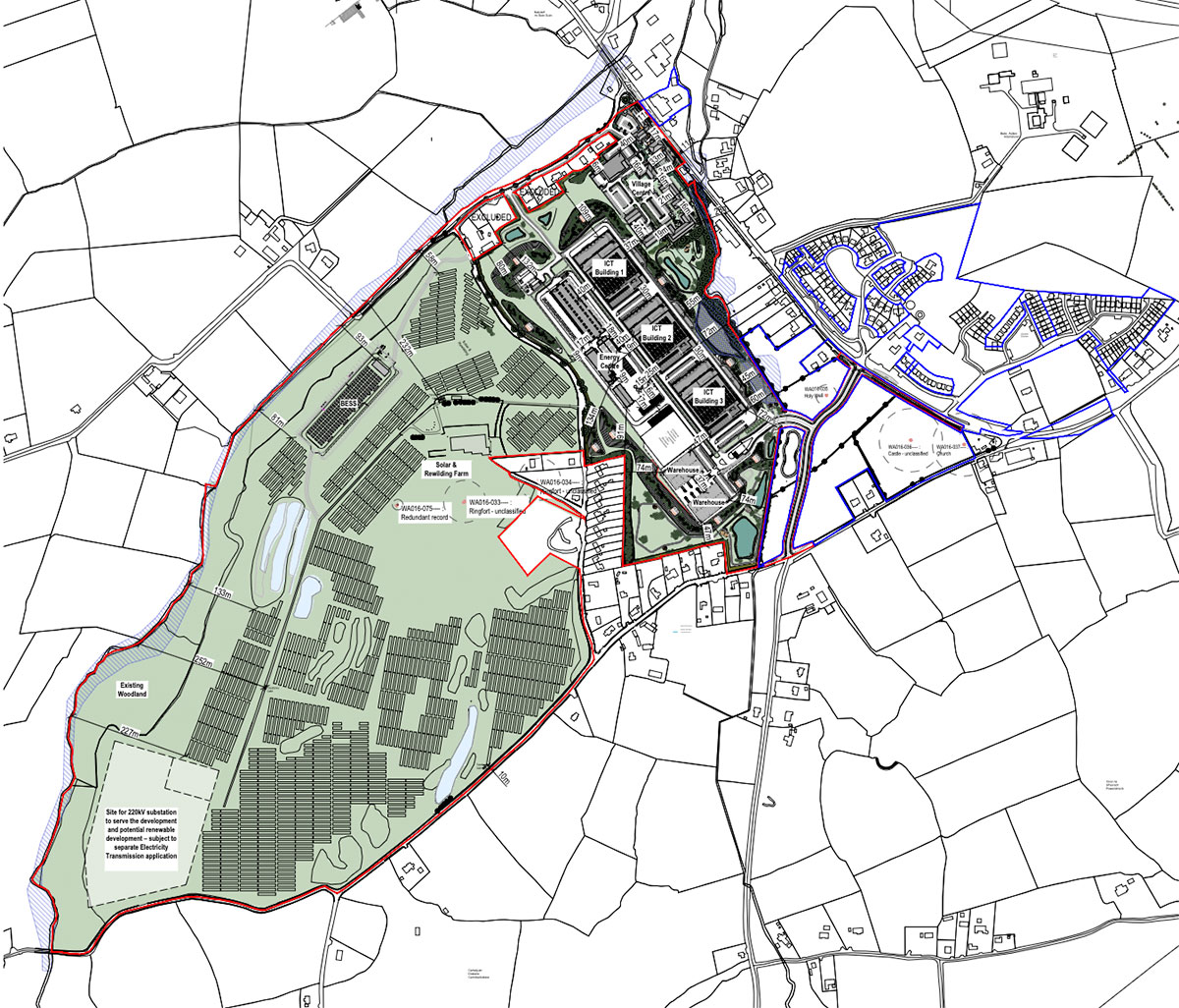
The development is set to be delivered on a phased basis with village and community assets delivered in the early phases as outlined in the application. The image below was submitted as part of the planning application.
Climate Policy
It is also in line with the criteria set down by the Commission for the Regulation of Utilities (CRU) in its 2021 directive to the grid operators in relation to data centre grid connections and also complies with proposed new CRU guidance on grid connections for Large Energy Users (LEUs) to be published later in 2025.
The energy centres on Echelon’s sites are a mandatory under the CRU’s policy and will only operate as a last resort to guarantee grid security in the region. EirGrid will have the capability to dispatch this generation to meet local, regional and national grid needs, as well as to support a greater volume of renewable energy projects to connect to the grid.
As Ireland decarbonises its national grid and more of our energy comes from wind and solar, energy centres such as this provide back-up for when the wind doesn’t blow and the sun doesn’t shine. Energy centres such as this help us make the transition to clean energy and are aligned with the government’s Climate Action Plan 2025 (CAP). The CAP has a specific target to deliver 2,000 MW of new flexible gas plant capacity to meet the country’s carbon reduction target in electricity generations by 2030.
In the short term, the energy centres will be powered by gas, although they will not be ‘always on’. In the medium term, we expect to be able to fuel the energy centres with biogas, or green hydrogen should it be available.
In the government’s Climate Action Plan 2025 (CAP) there is a specific target to deliver 2,000 MW of new flexible gas plant capacity to meet the country’s carbon reduction target in electricity generations by 2030.
- The initial site technical studies have identified the location as ideal due to its proximity to the national transmission grid.
- The impact to the water infrastructure will be mitigated by our exemplar water efficient design.
- The planned development will actually reinforce the wider utility infrastructure in the region and add new utilities like district heating to the new village centre with capability to extent to the wider community.
However, in line with the criteria set down by the Commission for the Regulation of Utilities (CRU) in its 2021 directive to the grid operators in relation to data centre grid connections, the development will include an energy centre that is capable of meeting the energy needs of the data centre, as well as dispatching energy to the grid, should it be required.
Air, noise and light pollution impacts
The noise chapter of the EIAR includes a detailed assessment of noise impacts during construction and operational stages, and details appropriate mitigation measures to avoid negative impacts.
When the site is operational there will be some increase in traffic volumes to and from the site, but as outlined in the detailed traffic and transport impact assessment, included as part of the application, there will be no significant impacts arising from the development once operational.
Road and access upgrades are proposed to align with planning policy and design standards.
Environment and sustainability
The development itself includes significant areas of open space with extensive native tree planting, and rewilding areas for integration and improvement of the biodiversity within and around the site.